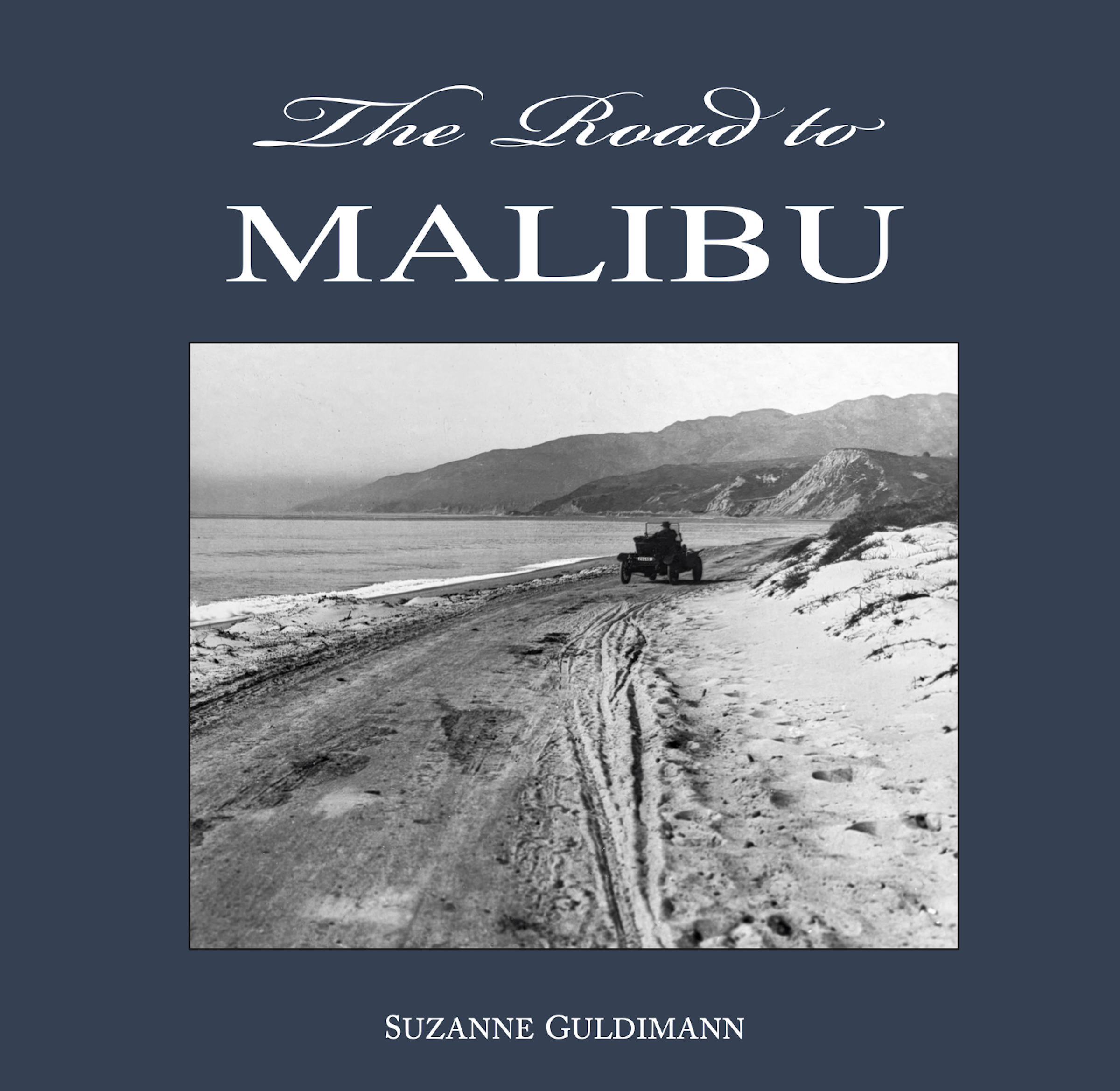
Suzanne Guldimann’s new book, The Road to Malibu, is out now. Order on Amazon, or email us to order from West of the Moon Books
The Road to Malibu. Suzanne Guldimann. West of the Moon Books, $45
Suzanne Guldimann’s third local history is a wild ride through Malibu’s past, with a deep dive into the history of Pacific Coast Highway, chapters on cowboy and surf culture, the Malibu Movie Colony, the Rindge family who once owned all of Malibu, and an in-depth look at the amazing tiles created by Malibu Potteries in the 1920s. The book is illustrated throughout with more than 250 historic photographs—some of which have never been published before—and with postcards, matchbooks, vintage advertisements, and other ephemera. www.amazon.com/author/suzanneguldimann
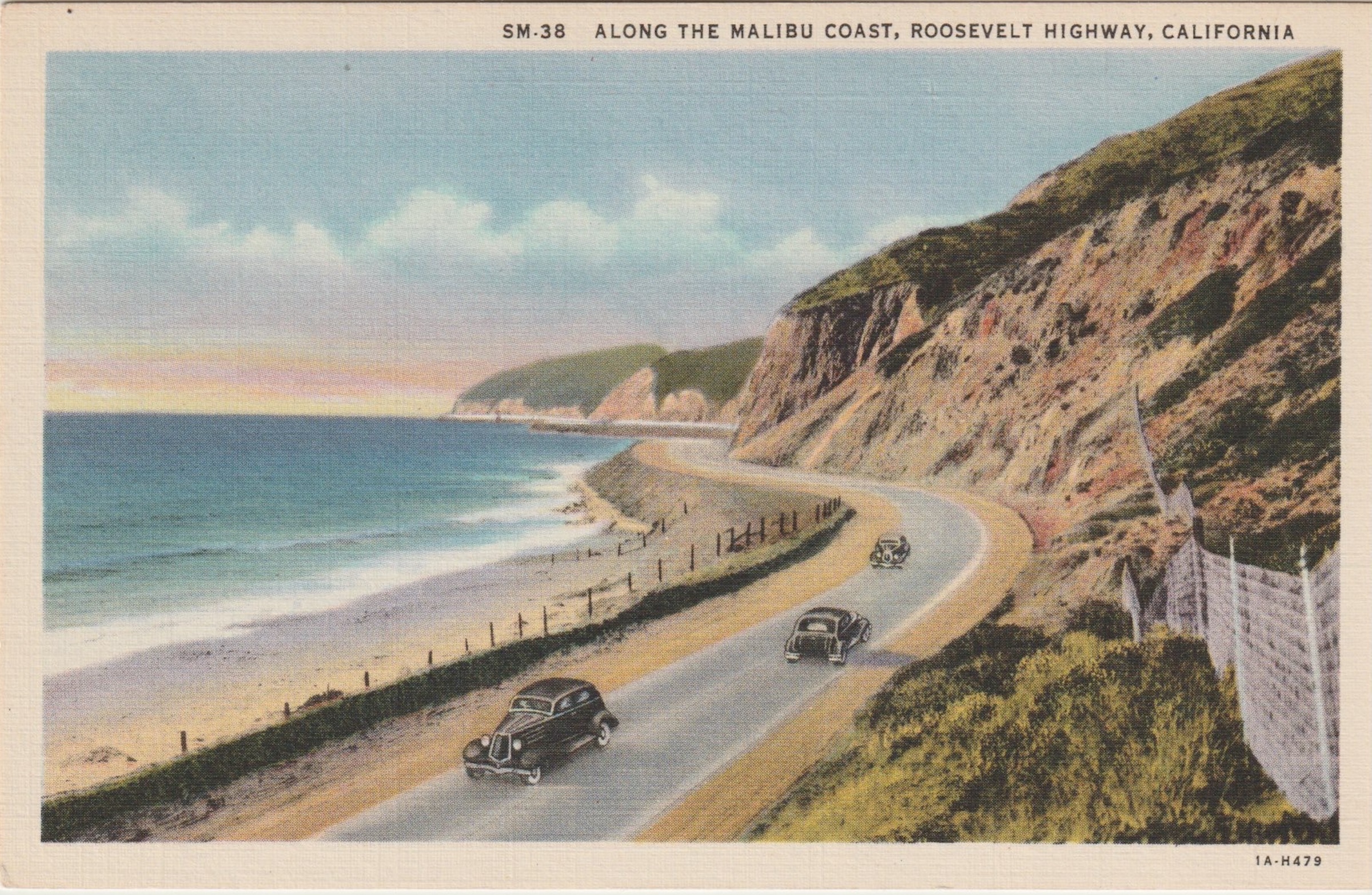
The road to Malibu was thrown open in 1926, after Malibu Rancho owner May Rindge lost the last of her appeals and legal battles over the right of way through the ranch. Road building began at once. This postcard reveals what the drive would have been like shortly after Roosevelt Highway (now Pacific Coast Highway) opened in 1929.
From the Introduction:
The gates of Malibu were thrown open to the public for the first time a hundred years ago. May Knight Rindge,widow of wealthy East Coast business mogul Frederick Hastings Rindge and the owner of the entire Malibu Rancho, lost her lengthy battle with the county over the right of way for the coast highway in 1925. The road began to be built the following year, and this mysterious, forbidden place was suddenly accessible for the first time. The highway would become a lifeline for Malibu and a constant source of problems. It is the route to the beach for millions of Angelenos, one of only two options to get from Los Angeles to Oxnard without going miles out of one’s way, and it is also Malibu’s Main Street. This road is storied and troubled, and its history is complex.
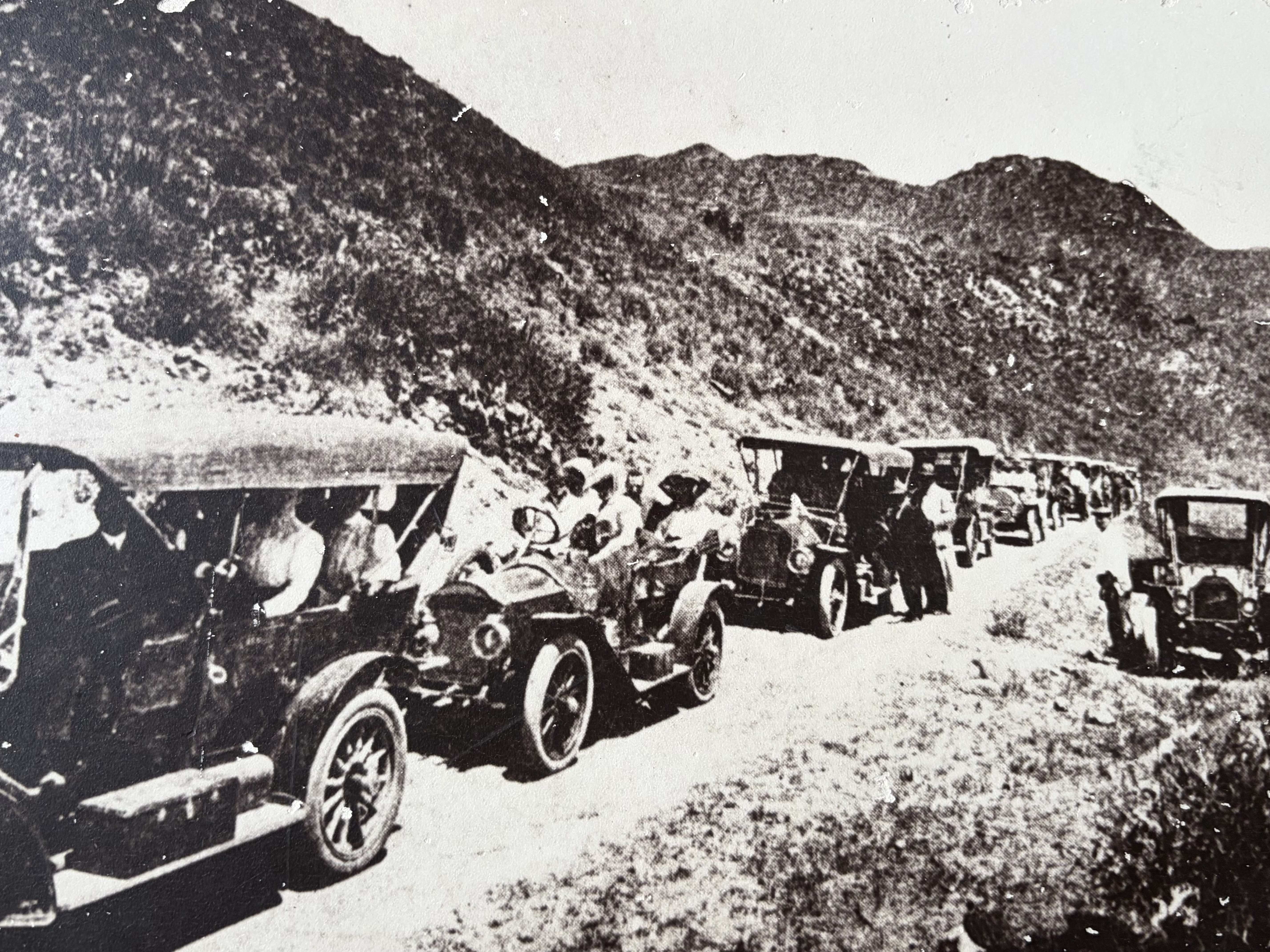
Members of the Southern California Automobile Club crowd the road to Malibu in what may have been the first local traffic jam in May of 1910. Lobbying from this organization helped pave the way (literally) for the coast highway. Photo from the author’s collection.
The Road to Malibu traces the evolution of the Pacific Coast Highway from cart track to state highway, but it is also a book about movie stars and filmmakers, cowboys and surfers, railroad tycoons and beach culture. Along the way, we’ll visit forgotten landmarks, a lost city, and the Malibu Colony in the silent movie era, and take a behind-the-scenes look at life on the Malibu Rancho when it was off limits to the world.
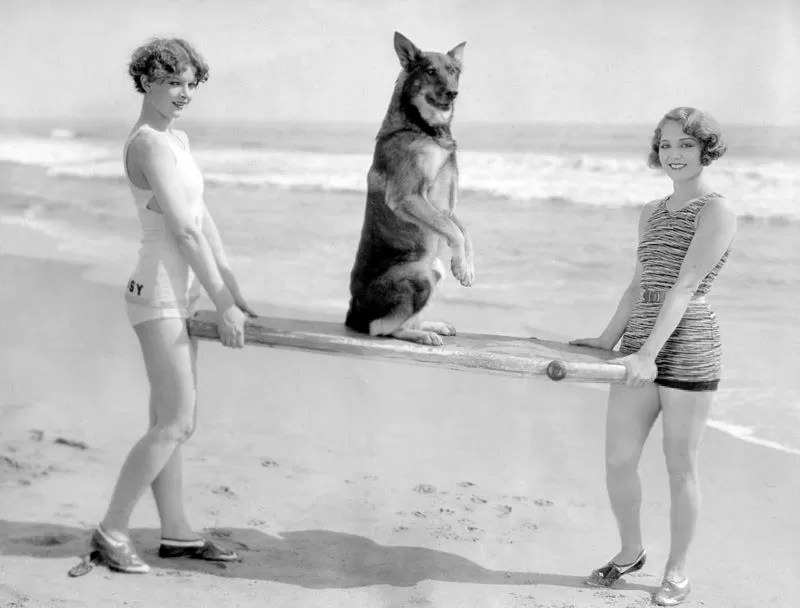
Silent film stars and Malibu Colony residents Myrna Loy and Leila Hyams pose with a surfboard and canine star Rin Tin Tin (also a Malibu resident) in this publicity photo from 1927. Early Hollywood had a major impact on the evolution of Malibu and Malibu’s surf and beach culture.
There are some detours here as well—to the pleasure piers of Santa Monica and Venice, and to Hawai‘i and South Africa and Australia for a surfing trip—but the road is the thread that ties most of the elements of this book together. Without it, there would be no Malibu surf or beach culture. No one loves the highway. It is dangerous and sometimes deadly, and it is inconvenient and frequently overloaded, but without it there wouldn’t be a Malibu—at least, not this Malibu.
In 1908, Santa Monica historian Luther Ingersoll wrote: “The Malibu grant, with its almost impassable mountain ranges ex-tending into the very ocean, its inaccessible canyons, its hidden mesas and wildernesses, has always been a land of mystery and many romantic stories of smuggling, of buried treasure, or robbery and murder have been connected with it.”
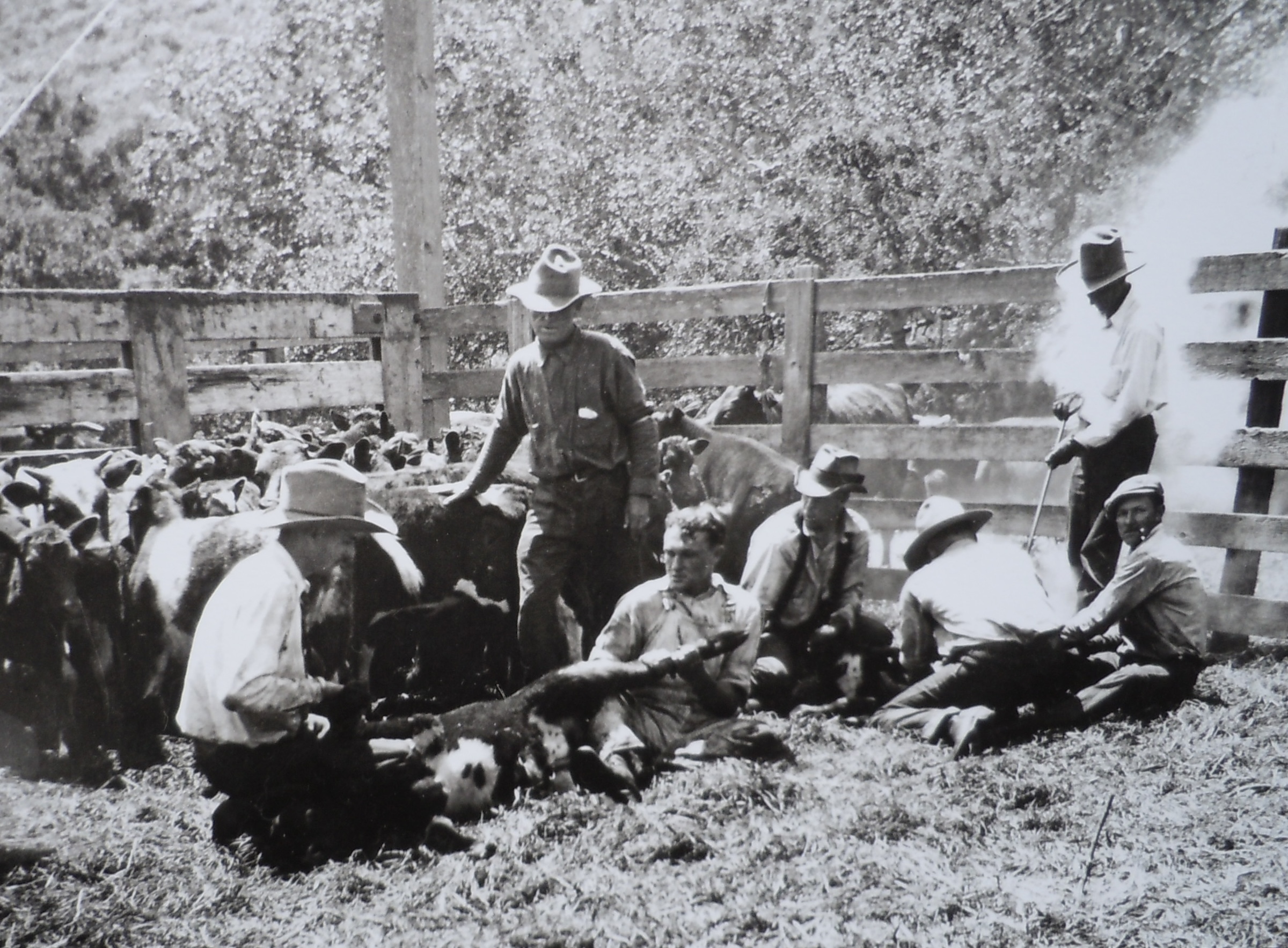
Malibu Rancho cowboys brand cattle at the Zuma Canyon “Home Farm” circa 1897.
The essays in this book were written over the course of about ten years. Things have changed in that time. Malibu is a perpetually shifting landscape. Not even Malibu Rancho owner May Knight Rindge’s stubborn determination could change that. No matter what humans build here, or dream of, or do, Malibu remains at heart wild and unpredictable. Nature is the ruling force. What the history presented in this book shows over and over again is that people and the things they build come and go, swept from memory by fire, and flood, and the relentless action of the ocean, or by the next wave of human activity.
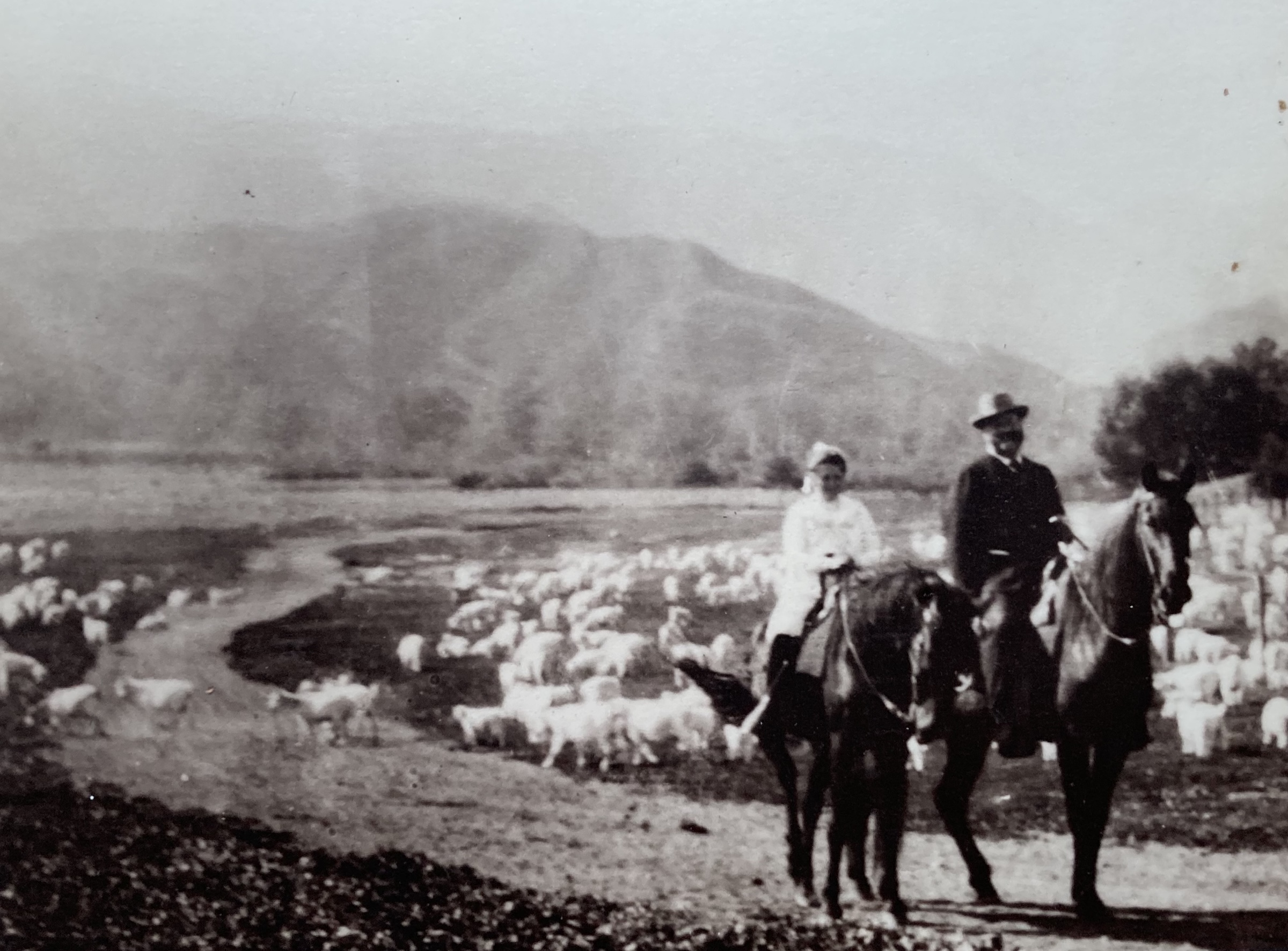
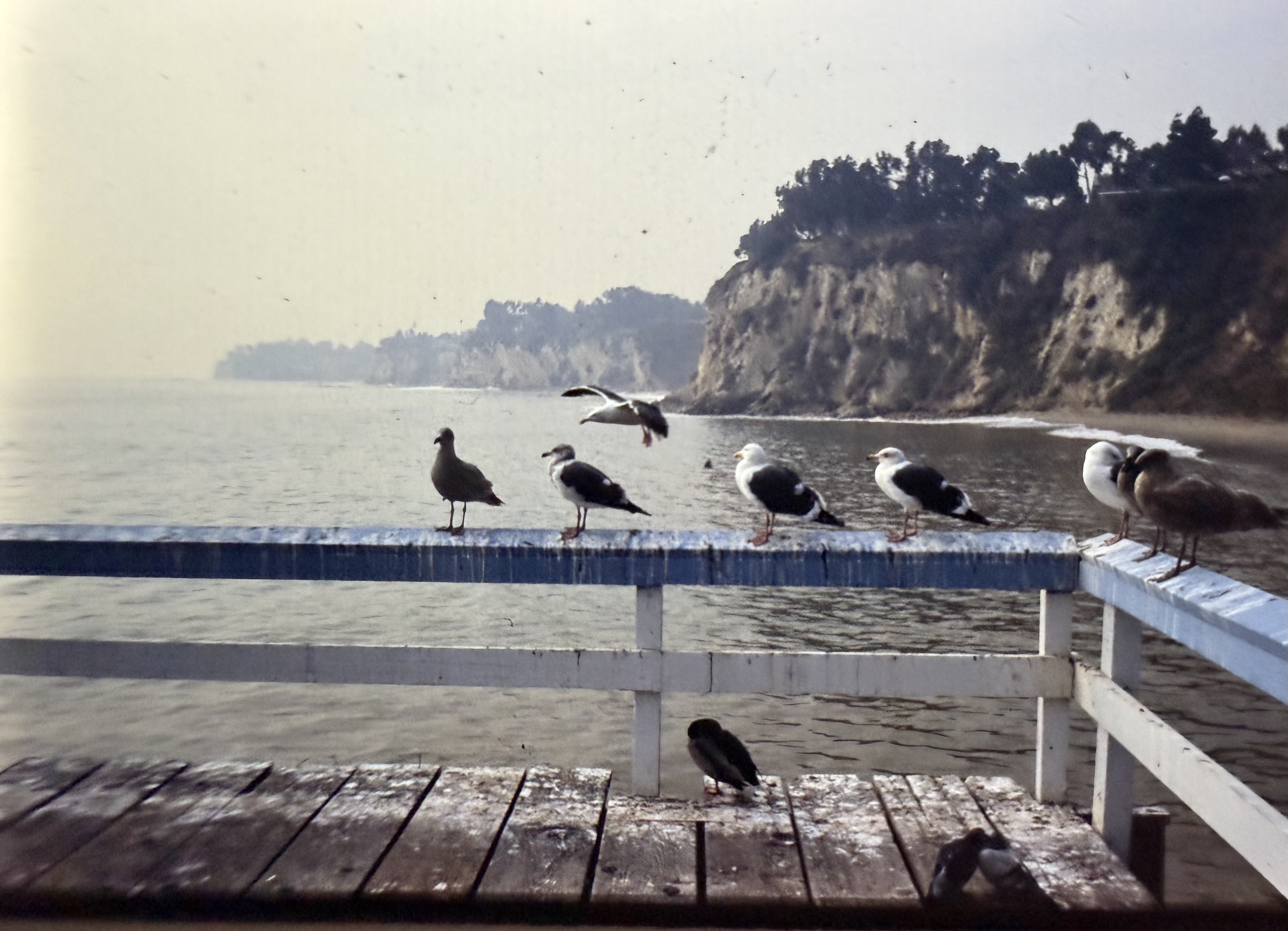
Before Hollywood, or surfers, or the beach culture, or the highway, Malibu was a working ranch. The Rindges—the photo shows family patriarch Frederick Hastings Rindge and his daughter Rhoda, circa 1900, riding through a flock of Malibu Rancho sheep at what is now the intersection of Pacific Coast Highway and Cross Creek Road.The view from the Paradise Cove Pier, photographed in 1983, the same year the historic structure was almost entirely destroyed by a powerful storm.
Malibu was still the Wild West when that description was written. More than a hundred years later, beneath the veneer of luxury homes and the glitter of celebrity lifestyles, the beating heart of this community is still wild. We have mountain lions in the garden; dolphins and sometimes great white sharks in the surf break; wildfire infernos with the devastating impact of a volcano; ocean waves with the power to wear down rock and devour houses; and tranquil mornings when the fog rolls in and wraps the coast in silent serenity.
All the beauties and joys of the Malibu coast are shaped and tempered by change. Not even the mountains remain the same—this is a young range that is still growing. Fires, floods, and landslides are as much a part of life here as sun and surf. It’s the dark side of the California dream, but the dream is still worth dreaming.
—Suzanne Guldimann Malibu, California
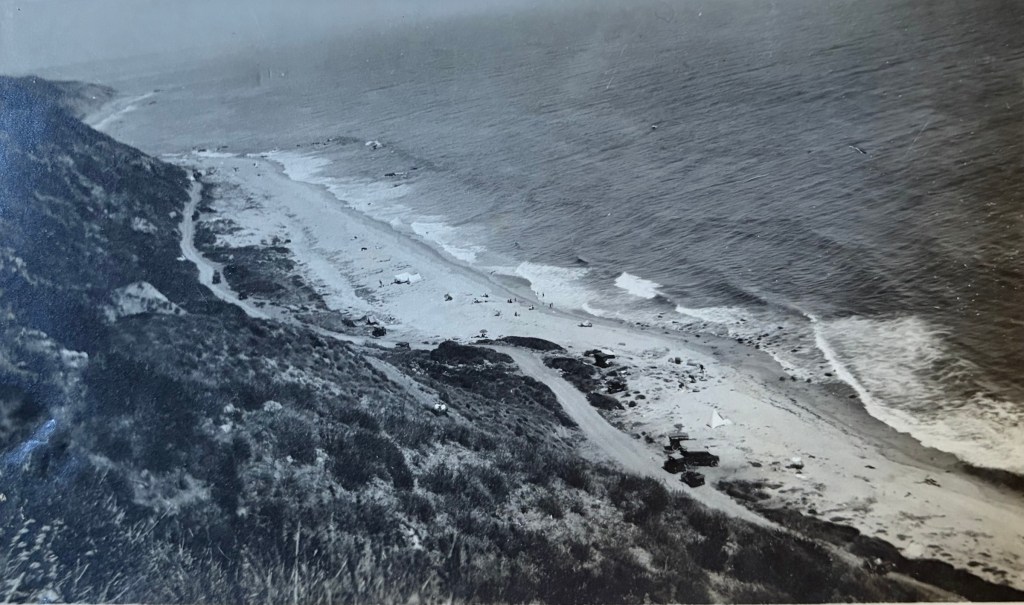
Campers pitch their tents on the side of the Malibu road before the highway was built. How did we get from here to where we are now? It’s a wild ride! Join author and local historian Suzanne Guldimann for a roadtrip to the past! The Road to Malibu is available online at Amazon or directly from West of the Moon Books.
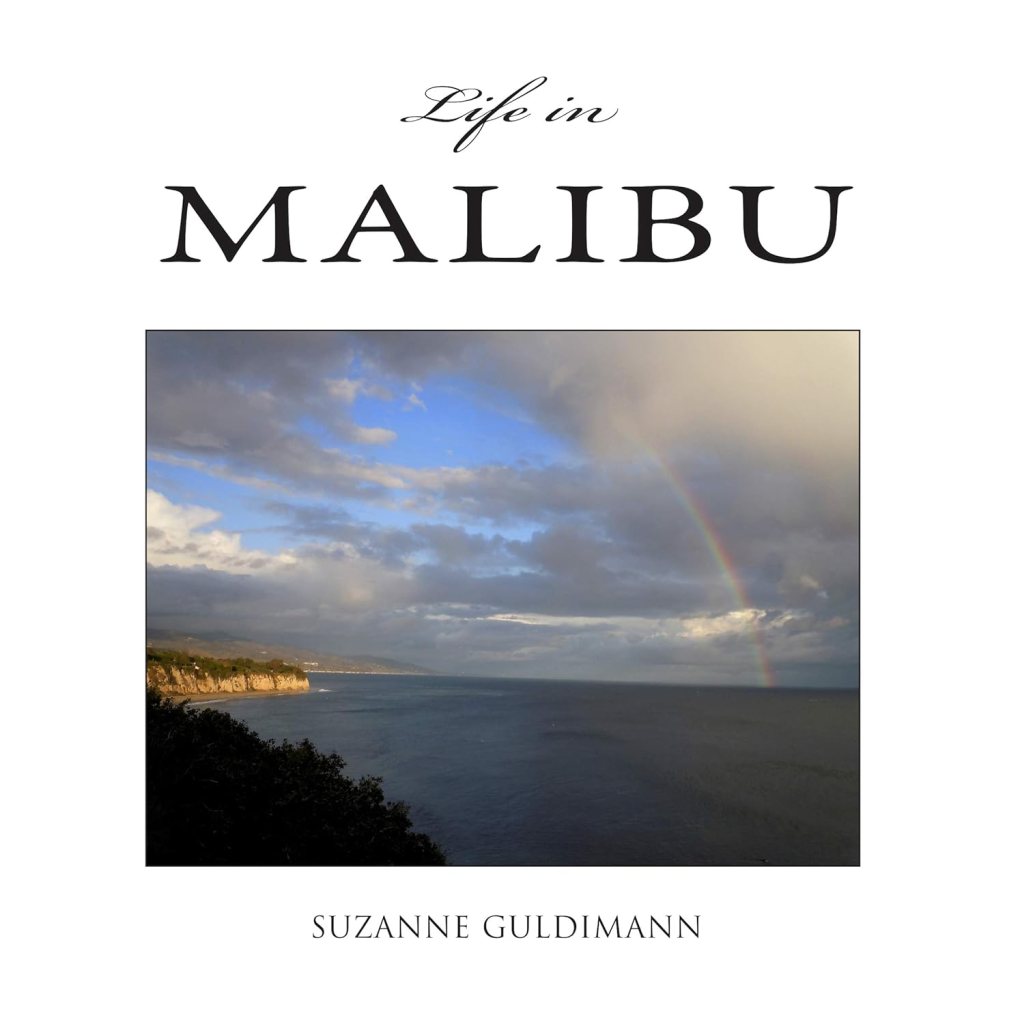
For West of the Moon Books’ 20th anniversary and 10th title we took a detour from harp music to present Life in Malibu, a collection of essays and photographs on the history and natural history of author Suzanne Guldimann’s hometown, one of the most celebrated seaside communities on earth.
I published my first book of harp music in 1998. In that ancient era there was little music available for the Celtic harp and even less for lap harp.
Green Grows the Holly was an entirely home grown effort, assembled on my first Apple MacIntosh and illustrated with my own woodcuts and ink drawings. Each page of text or music had to be printed out and photographed individually to create the final manuscript.
In order to publish the book I needed to start a publishing company. I picked the name West of the Moon Books, filed for a DBA, and bought a block of 10 ISBN numbers—international standard book numbers—with no expectation that I would ever use them all. That’s all it took to become a publishing house—that and something to publish.
When I was a child I wanted to be a writer and illustrator when I grew up. I didn’t know it then, but Green Grows the Holly was the first step toward that goal, if not in the way I had envisioned.
That childhood ambition may be why I chose the name West of the Moon, in part for the fairytale about the red-haired girl and the Great Bear of the North, and partly for J.R.R. Tolkien’s poem that goes:
Still road the corner there may wait
A new road or a secret gate
And though I oft have passed them by
A day will come at last when I
Shall take the hidden paths that run
West of the Moon, East of the Sun.Over the next two decades I published nine books of music for the harp. Between the harp books and along the way I went back to school and got a masters degree. I changed careers and became a journalist. I’ve written over a thousand articles for the local media about Malibu and the Santa Monica Mountains, the place where I grew up and still live, the place that I love.
My first non-harp book, Life in Malibu, is a collection of essays on Malibu’s history and natural history that grew out of this chapter of my life. It was published just in time for West of the Moon Books’ 20th anniversary. That 10th ISBN number that I never thought I’d need is on the cover.
The harp books and Life and Malibu come from the same desire: sharing something that I love and care deeply about with a wider audience. Life in Malibu includes chapters on the history of Pacific Coast Highway, the lives of the mountain homesteaders in the early 20th century, a short history of surf culture and how Malibu’s beaches were saved, a guide to seeing and identifying whales and marine mammals, a look at local wildlife, and the physics of the kind of mirage we often see on the horizon, once attributed by sailors to the sorceress Morgan le Fay. The book is illustrated with archival and original photographs.
Life in Malibu is now available on Amazon. My 10th collection of harp music, A Song for the Moon, is due out in 2019. Time to buy some more ISBN numbers.
Suzanne Guldimann West of the Moon 21 December 2018
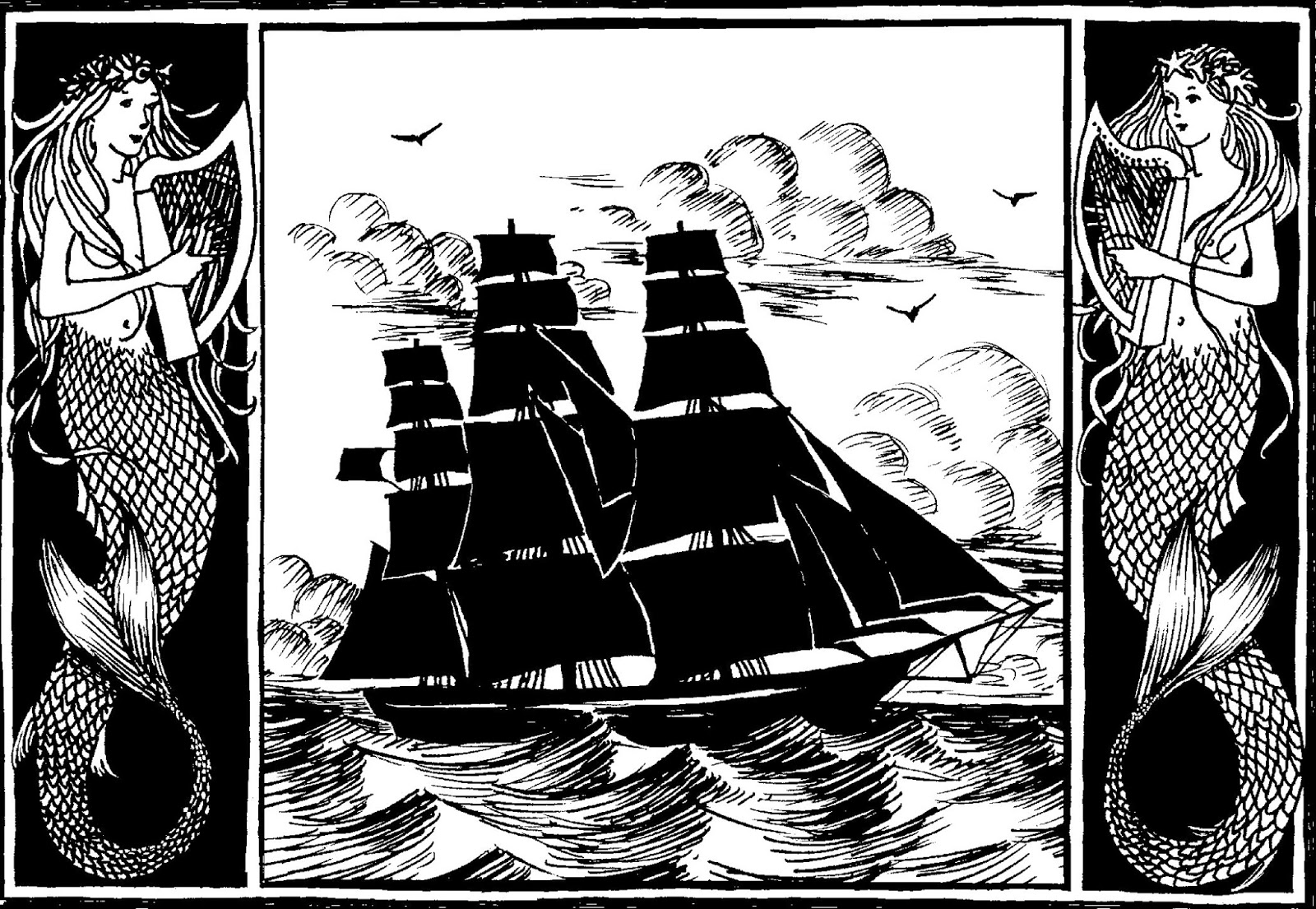
The cover art that I drew in 2002 for my book Hearts of Oak.
Writing a book is a leap of faith. Publishing it yourself suggests Douglas Adam’s definition of the art of flying: throwing yourself at the ground and missing. That thought has been in my mind quite a lot lately, as I struggle to reformat my book Hearts of Oak: Songs and Dances of Old England, originally published in 2002, into a form that can be reprinted in 2014.
Hearts of Oak was the last of my harp books to be printed using an offset press. The printer and his dinosaur-sized equipment is long gone and so are the original photographic plates. The files, most of them created using software that is now as obsolete and extinct as any sauropod, have had to reassembled, and in some cases reconstructed, from the ground up.
What was I thinking in 2002, as I stitched together a patchwork of ballads, country dances and sea shanties? And is it worth the effort now to redo all of that work? It would be easier to just let it slip out of print, I told myself. And then I sat down at the harp and played through all the plaintive airs and intricate dance tunes, and I remembered why it was important, why it was worth the effort then and is still worth it. Besides, as far as I know, it’s just about the only harp collection out there full of pirate songs.
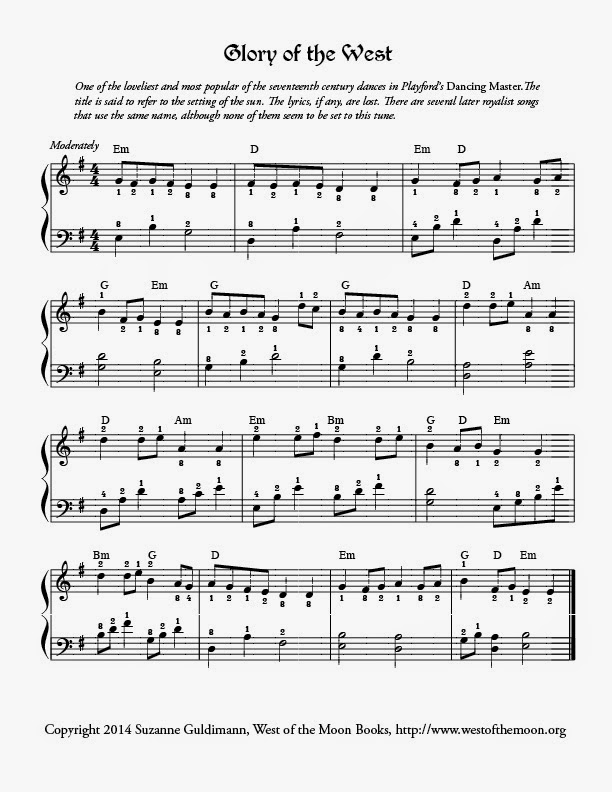
Here’s one of my favorite pieces from the book. It’s not a pirate song, it’s a 17th century English country dance, all neatly reset, and ready for another 12 years in print.
The ninth collection of harp music from Suzanne Guldimann is complete! Music for the Netherfield Ball: Songs and Dances of Jane Austen’s Era debuted this month as an ebook. The print edition will be available this summer. The book has already made the news in the Jane Austen Center’s online newsletter, which was both humbling and a thrill for the author, a longtime Austen enthusiast.
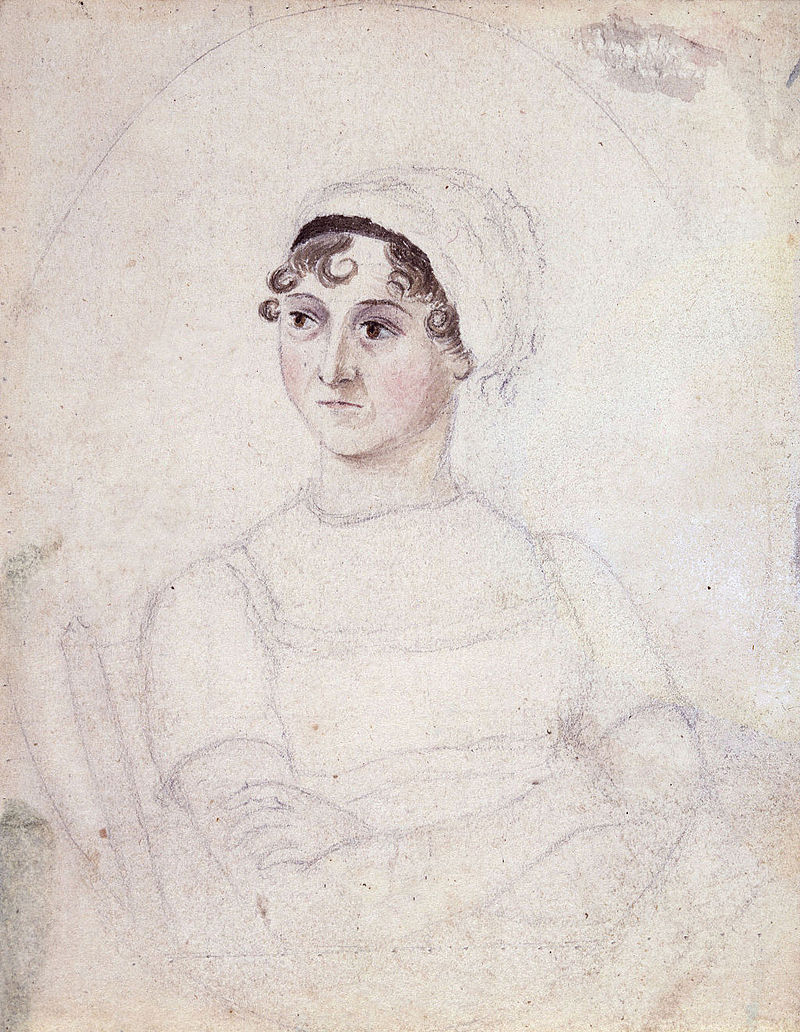
This somewhat disapproving sketch of Jane Austen, drawn by her sister Cassandra, is the only authentic period portrait of the novelist.
Guldimann read Jane Austen’s works for the first time not long after discovering the Celtic harp. She was 13. While she loved both, she never thought to put the two together until she encountered a booklet about the Austen family’s music collection.
In 2005, researchers Ian Gammie and Dr Derek McCulloch published a catalogue entitled Jane Austen’s Music. It was the first complete appraisal of the eight books of music once belonging to Austen and now housed at the Chawton House Library, in Hampton, UK, which had, in the words of the authors, “never before been fully catalogued and on closer inspection proved to have 300 musical items.”
I was fascinated to learn how eclectic and varied that music is, ranging from what we would consider classical, to the popular songs of the day. I was especially intrigued that the collection contained numerous Scottish and Irish folk songs that would be classed today as “Celtic.”
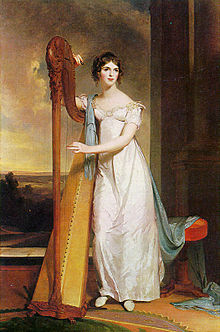
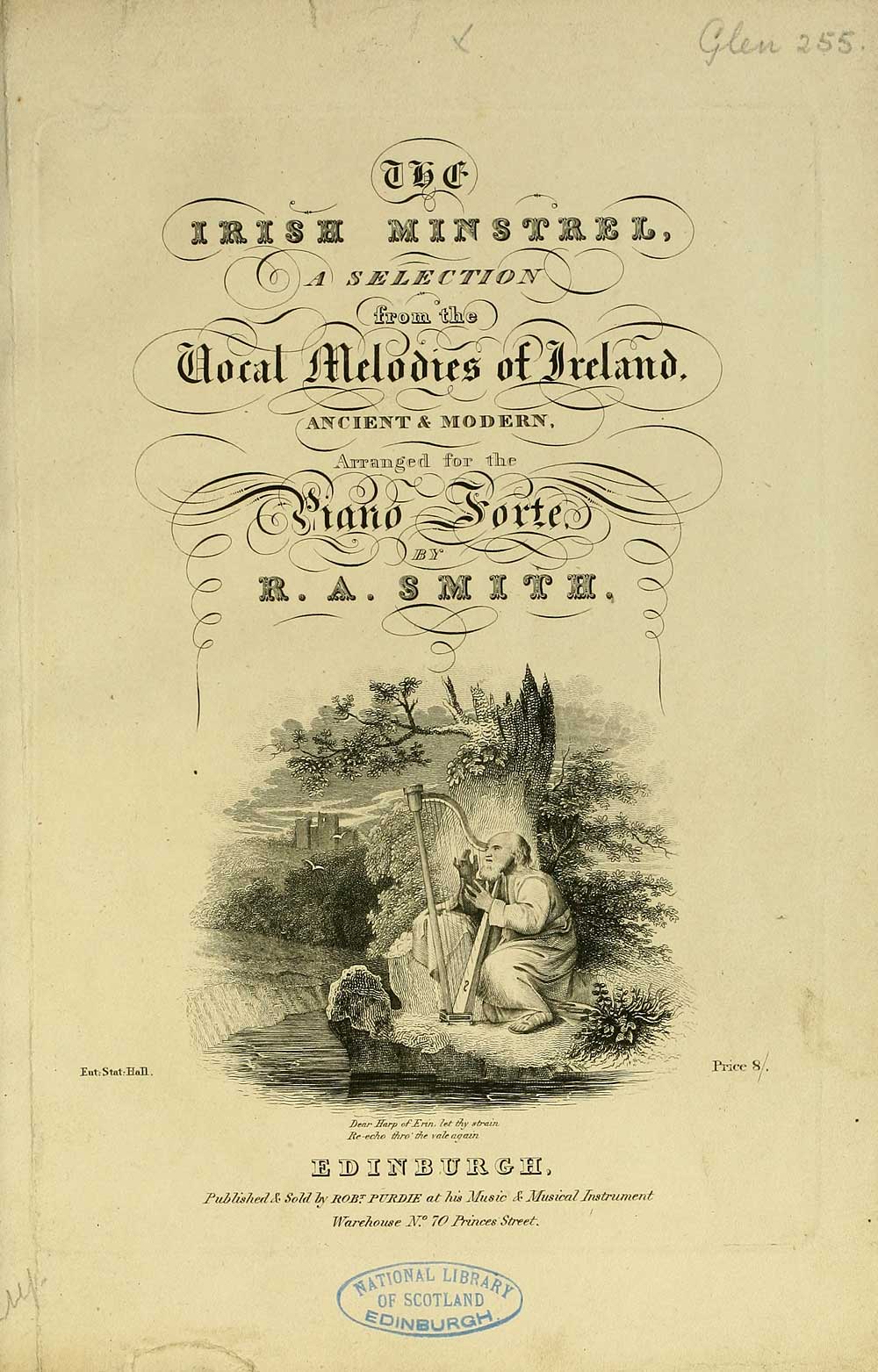
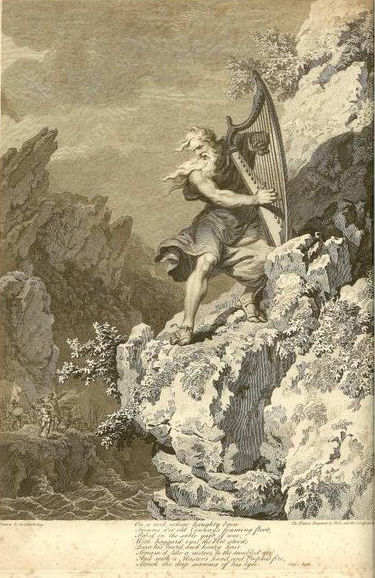
The single-action pedal harp, invented in the early 18th century, was extremely popular throughout the Regency period, replaced in the early 19th century by the modern double-action concert harp. However, the old harp traditions of Ireland, Scotland, and Wales had not entirely vanished and were a surprisingly significant element in the evolution of the concert harp and the popular music of era. Artist Thomas Sully depicted the type of harp Jane Austen would have been familiar with in his portrait of Eliza Ridgely, painted in 1817, the year Austen died. Image: National Gallery of ArtThe harp music and traditions of the old harpers were collected, romanticized and recycled as part of the Romantic movement’s insatiable enthusiasm for folklore. Poets like Robert Burns set new verses to the old tunes. Dramatic and improbable illustrations of bards decorated collections of that music, like this one in the Glen Collection of the National Library of Scotland, circa. 1825.Here’s an even more romanticized illustration of a Welsh bard this time from Musical and Poetical Relicks of the Welsh Bards, published in 1784. Neither gentleman seems disconcerted that they and their instruments are precariously close to the edge of the water.
Currently, the Chawton Library houses 17 volumes of music once owned by the Austen family. They are a mix of printed sheet music and hand copied pieces, composed music and traditional airs. Three volumes have music that were copied out by Jane herself. Several others are inscribed with her name. Jane played the pianoforte, not the harp, but she was familiar with the instrument. The single-action pedal harp, invented around 1780, was a popular instrument in Austen’s lifetime. This was the instrument played by accomplished—and wealthy—young women like Mr Darcy’s sister Georgiana in Pride and Prejudice, the worldly and wealthy Mary Crawford in Mansfield Park, and by Austen’s own somewhat scandalous cousin, Eliza de Feuillide.
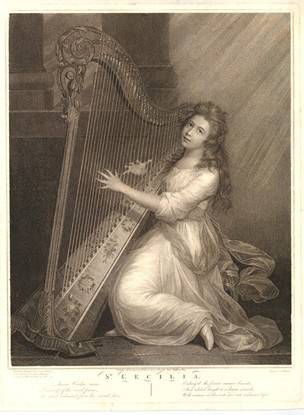
A portrait of a young harp player named Emily de Visme as Saint Cecilia, the patron of music, by London artist William Bond, c. 1795. The harp was a popular instrument with fashionable, wealthy young women in Regency England but also throughout western Europe. Marie Antoinette had a harp so spectacularly decorated with jewels and gold gilt that it is hard to image anyone playing it. Benjamin Franklin reportedly learned to play the harp while serving as ambassador to France. Image: The British Museum
As Guldimann delved deeper into the musical world of Jane Austen she found an unexpected connection in the traditional airs to the ancient harping traditions of Scotland, Ireland and Wales. The Romantic movement that sent folklorists and song collectors in search of forgotten lore revived portions of those traditions. They embellished the songs with a baroque profusion of ornament and set new lyrics to them, but the airs themselves remain rooted in history.
Some of the traditional Welsh harpers found new employment performing and teaching when the single-action harp was imported from France in the 18th century. A Welsh harper reportedly performed Handel’s celebrated harp concerto when in debuted in London, and George III, king during Austen’s lifetime, and his son the Prince Regent (for whom the Regency era is named), each had a royal Welsh harper at court.
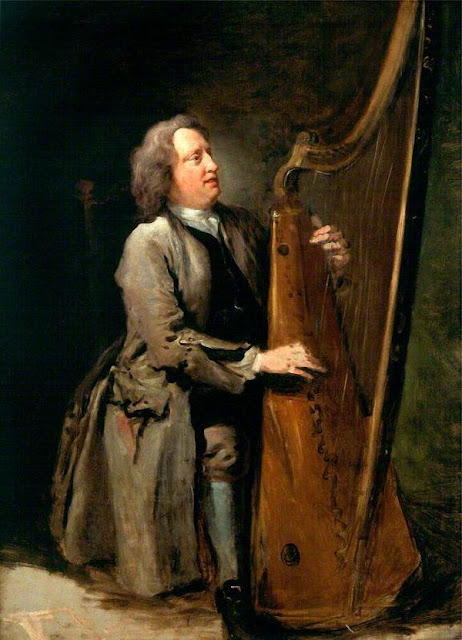
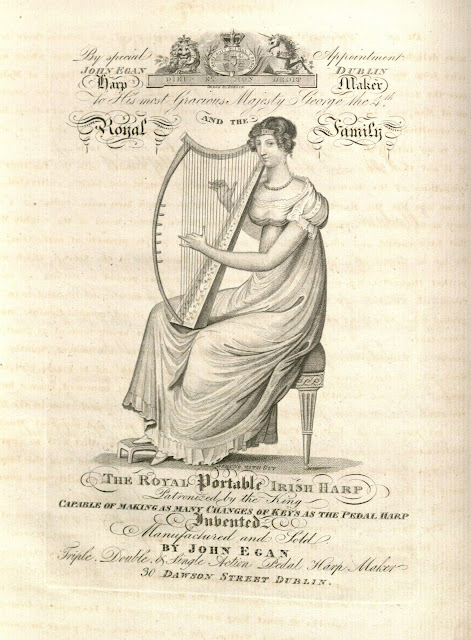
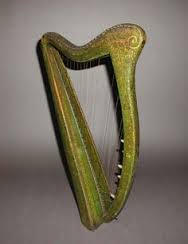
Traditional Welsh bards, like blind harper David Lewis, shown here in a portrait by William Hogarth, were an important part of the 18th century harp phenomenon. They moved in London society, adapting old techniques to the new harp, performing and teaching. Handel’s Harp Concerto debuted in 1736 at Covent Garden, and was performed for the first time by a Welsh harper. Harp maker John Egan, inspired by the revival of interest in the Irish harp tradition, introduced the “Royal Portable Irish Harp,” technically one of the first “modern” Celtic harps, in 1815.Here’s an actual example of Egan’s attempt to recreate the ancient harp of Ireland. It’s possible that a careful study of the visual record of the era might reveal evidence that at least a few ancient harps may have survived as parlor instruments.
Music for the Netherfield Ball contains a selection of the Scottish and Irish traditional airs so popular in the era, including several attributed to the old harpers, together with composed pieces by Mozart, Handel and Gluck, and a smattering of Welsh, French and Italian folksongs. All but one of the 19 tunes in Music for the Netherfield Ball have a direct connection with the Austen family, two pieces are said to have been among Jane Austen’s personal favorites.
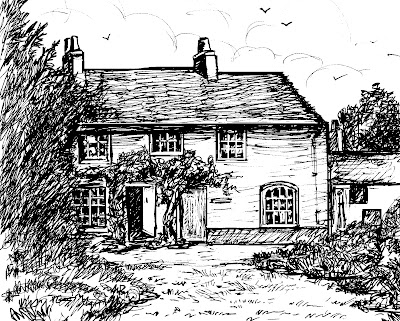
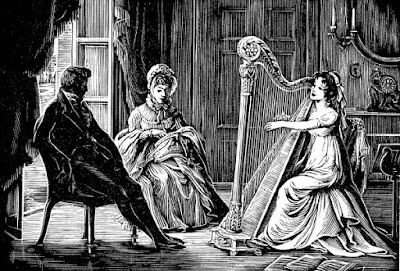
Pleasant and entirely Georgian Chawton Cottage, where Austen spent the last nine years of her life, seems entirely removed from the excesses of Romantic sensibilities, but much of the music Austen loved to play on her pianoforte each morning was steeped in that romance: old ballads, revised and gilded by poets like Robert Burns; folksongs with their roots in antiquity; and airs attributed to the old harpers, recycled but still vibrant. Illustration @ 2016 S. Guldimann
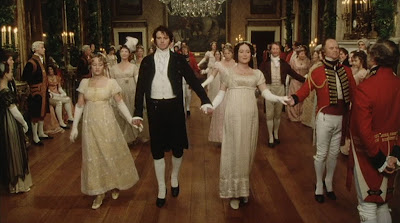
The 19th piece in the collection slipped in by way of the 1995 television adaptation of Pride and Prejudice. “Mr Beveridge’s Maggot” predates Austen’s era by more than 100 years and is regarded by the experts in all-things-Austen as entirely anachronistic in its use as a dance, but it’s much-loved by many Janites, including the author.
The English country dance tune “Mr Beveridge’s Maggot” was used to great effect in the 1995 A&E version of Pride and Prejudice. So much so that it’s become a favorite with many Janeites, despite the fact that the experts regard the tune as 100 years out of date for Austen’s era. I couldn’t resist including an arrangement, even if it makes the purists shudder with horror. There are at least two tunes in the Austen family music collection that originate in the same collection of dances that this one was drawn from: Playford’s English Dancing Master, so perhaps it isn’t quite so anachronistic if used as an occasional piece and not as a dance.
In assembling the music for this collection, Guld imagined it as a sampling of occasional music that might be played at a country gathering like the Netherfield Ball in Austen’s Pride and Prejudice: a mix of popular music, folk songs, and composed works, intended to entertain and give joy.
Mary Crawford enchants the gullible Edmund in this stellar woodcut illustrator for Mansfield Park by artist Jean Hassall.
Guldimann began researching this project in 2009, with the goal of publishing the collection in time for the 200th anniversary of the publication of Pride and Prejudice in 2013. Instead, the publication was released just in time for the 200th anniversary of Austen’s death in 2017.
Almost all of the pieces in this collection can be played on a harp with a range of just two and a half octaves (a couple of pieces go up to the C above high C and require a few extra strings this time) the music can be played on any harp or melody instrument. Guldimann has arranged the music for the convenience of 21st century musicians, and has transposed and adapted where necessary. The arrangements include harp fingering, chord symbols, historical notes and lyrics.
Regarding her inspiration for the cover art, Guldimann said, “Many years ago, a friend gave me an Irish farthing coin like this one, for luck. The harp on the cover of my book is inspired by that mythical harp of Ireland, decorated with a winged and fish-tailed siren. Regardless of whether the actual instruments continued to be played, the ancient harp has remained a symbol of Irish identity, and the music associated with the tradition had as much cachet in Jane Austen’s era as it does today.”
Music for the Netherfield Ball is available in ebook and print form. The collection includes: